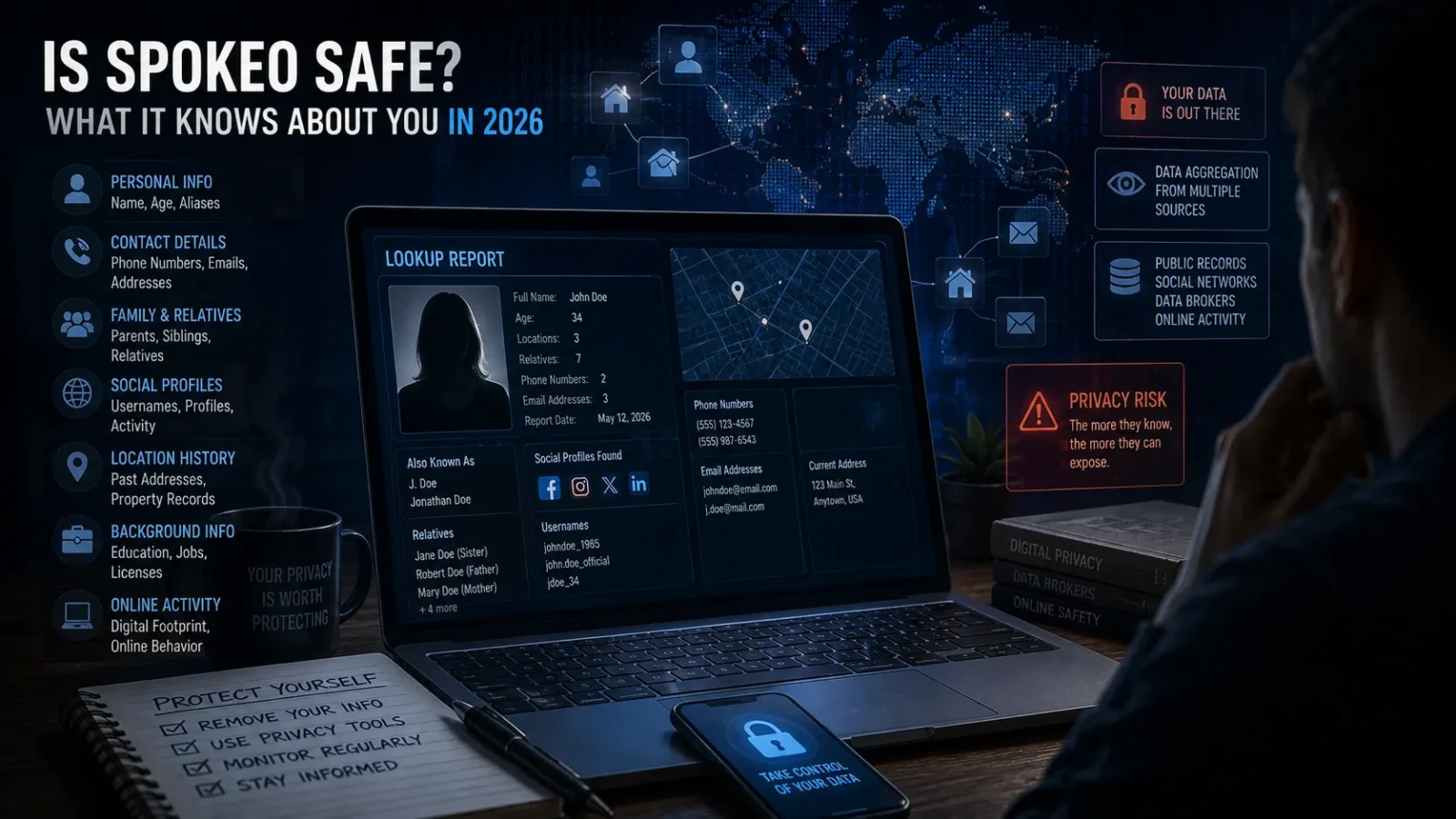
Type someone’s name into Spokeo and within seconds you’ve got their age, their old addresses, their relatives, maybe even their phone number. It feels a little too easy. And if you’ve ever searched your own name and found yourself sitting there for anyone to see, you’ve probably asked the same question we’re answering today.
Short answer: Spokeo is safe to use if you’re the one searching. It’s a legal company, not a scam, and your payment information is handled the normal, secure way. But if you’re the person being looked up, “safe” gets a lot more complicated, because Spokeo has no way of knowing whether the person searching for you is an old friend, a landlord doing due diligence, or someone you’d rather never find you.
Let’s go through exactly what Spokeo does, where it actually gets its information, whether it’s legal, and what you can do if you don’t want to be on it.
What is Spokeo Used For?
Most people land on Spokeo for pretty ordinary reasons. Reconnecting with an old classmate. Checking out a name before a first date. Looking up a phone number that just called you three times in a row. Landlords and small business owners sometimes use it for a quick, informal check before doing business with someone new.
That’s the intended, legal use case. What Spokeo is not meant for, and explicitly says so in its own terms, is anything covered by the Fair Credit Reporting Act, deciding whether to hire someone, rent to someone, or extend them credit. More on why that matters in a minute.
How Does Spokeo Get Its Information?
Spokeo doesn’t hack anything or buy stolen data. It pulls from sources that are, technically, already public or semi-public:
- Public records: Property records, marriage and divorce filings, court records, business licenses
- Social media: Profile info you’ve made visible on platforms like Facebook, LinkedIn, and Instagram
- Licensed data broker feeds: Spokeo buys and trades data with other aggregators, the same way most people-search sites do
- White pages and phone directories, including older, offline sources
- Marketing and survey data that gets resold in bulk
Is Spokeo legal? Here’s The Real Answer
Yes, Spokeo is legal. But the honest version of how is Spokeo legal isn’t as simple as “public records are fair game.” Spokeo has actually been in real trouble with the government over this before.
In 2012, the Federal Trade Commission fined Spokeo $800,000 for operating like a consumer reporting agency without following the rules that come with that, namely, making sure the data was accurate and only sold to people with a legitimate reason to use it. The FTC also caught Spokeo posting fake “independent” reviews of its own service that were actually written by its own employees. That’s a real, documented case, not internet rumor, and you can read the FTC’s own press release on it if you want the primary source.
Since then, Spokeo has stayed on the right side of the law by drawing a hard line: it is not a consumer reporting agency, and it says so, loudly, on every page. You legally cannot use Spokeo’s data to decide whether to hire, house, or lend money to someone. If you do, you’re the one breaking the law, not Spokeo, the company has structured its terms so that responsibility falls on the user, not the platform.
Is Spokeo a Scam, Or Is It Legitimate?
Is Spokeo legitimate? Yes. It’s a real, registered company that’s been around since 2006, it’s publicly known, and it pays out real settlements when it breaks the rules, which isn’t something a fly-by-night scam operation typically sticks around to do.
Is Spokeo a scam, then? No, but “legitimate” and “trustworthy in every way” aren’t quite the same thing. The fake employee-written reviews the FTC caught back in 2012 are a real black mark, even years later. And the more common complaint we found isn’t about spokeo fraud in the criminal sense; it’s about billing. A lot of people sign up expecting a one-time report and end up on a recurring monthly subscription they didn’t fully notice agreeing to. That’s a legitimate business practice, technically, but it’s also exactly the kind of thing that makes people search “is Spokeo a scam” in the first place.
How Accurate is Spokeo?
Mixed, honestly. Because Spokeo pulls from so many different sources, it’s common to see an old address that hasn’t been your home in years, a phone number that’s been disconnected, or a relative listed who you haven’t spoken to in a decade. Spokeo itself says right in its terms that the data “may not be complete, comprehensive, accurate, or even up-to-date.”
So how accurate is Spokeo in practice? Accurate enough to find the right person most of the time, but not accurate enough to rely on for anything important. Treat it as a starting point, not a verified fact sheet.
Is Spokeo Free?
Technically, yes, and technically, no. Spokeo lets you run a search and see a preview for free, usually a blurred-out summary that confirms it found something. To actually see the details (the full address, phone number, background info), you need to pay. Plans generally run in the range of $20–25 a month, with cheaper rates if you commit to a longer term.
So is Spokeo free in any meaningful sense? Not really. The free part is just a teaser designed to get you to unlock the paid report.
Does Spokeo Notify the Person You Looked Up?
No. Does Spokeo notify the person being searched? Never. There’s no alert, no email, no notification sent to the person whose profile you just viewed. This cuts both ways: it’s convenient if you’re just being nosy about an old friend, but it also means someone with less friendly intentions can look you up without you ever knowing it happened.
So, Is It Actually Safe to Use Spokeo?
If you’re searching: yes, it’s safe. You’re not going to get hacked, scammed, or have your own information exposed just by using the site. Just watch the billing. Cancel the subscription if you only wanted one report.
If you’re the one being searched: it depends entirely on who’s looking, and you’ll never know who that is. For most people, this is a low-stakes annoyance, maybe some extra spam calls. But if you’re dealing with an ex who won’t let go, a stalker, or you’re trying to stay hidden after leaving an unsafe situation, having your current address sitting on a site like Spokeo is a genuine physical safety risk, not just a privacy inconvenience.
One thing worth remembering: if someone uses what they find on Spokeo to make a hiring, housing, or lending decision about you, that’s illegal on their part under the FCRA, which won’t undo the damage, but it does mean you have a real legal footing if it happens.
Can You Remove Your Info From Spokeo?
Yes, and it’s more straightforward than most people expect:
- Search your own name on Spokeo to find your profile.
- Copy the URL of that specific profile page.
- Go to Spokeo’s opt-out page and paste in the URL, along with your email.
- Confirm the removal through the verification email Spokeo sends you.
- Give it a couple of days. Most removals go through within 24 to 72 hours.
The catch: this only removes that one listing. Spokeo (and every other data broker out there) tends to re-collect and re-list information over time, so a one-time opt-out isn’t a permanent fix. Plenty of people end up repeating this every few months, or eventually turn to an automated data removal service to handle re-checking for them.
Frequently Asked Questions
Is it safe to use Spokeo?
Yes, if you’re the one doing the searching, your payment and search activity are handled securely. It’s a different question if you’re the one being searched, since you have no control over who’s looking or why.
Is Spokeo really free?
Only the basic preview. Seeing full details like an address or phone number requires a paid subscription, usually $20–25 a month.
Do people know if you look them up on Spokeo?
No. Spokeo never notifies anyone that their profile was viewed. Searches are completely one-directional.
Can I remove my info from Spokeo?
Yes. Find your profile, copy the URL, submit it through Spokeo’s opt-out page, and confirm via email. It usually takes a few days, though your data can reappear later and need to be removed again.
The bottom line
Spokeo isn’t a scam, and it isn’t secretly illegal; it’s a real company operating in a legal gray zone that Congress never fully anticipated when it wrote the FCRA. The genuine risk here isn’t Spokeo hacking you.
It’s that your own public information has been organized into one convenient page, and Spokeo has no way of vetting who’s on the other end of that search. If that thought bothers you at all, that’s reason enough to look up your own name and see exactly what’s there.